Dreaming What Myth Onward?
In its initial reception, The Red Book seemed more than promising. The New York Times, in its 2009 review, called it a singular work beyond categorization: “As an inquiry into what it means to be human, it transcends the history of psychoanalysis and underscores Jung’s place among revolutionary thinkers like Marx, Orwell and, of course, Freud” (Harrison 2009). Indeed, looking back over the last decade and a half since its release, it is clear that the fascination with the book has piqued keener public interest in Jung’s psychology.
Before its publication, Jung had already been celebrated as a countercultural icon, but was still persona non grata in academia, existing principally on the fringes. The last two decades have seen him move closer to the mainstream of the Zeitgeist, a phenomenon propelled not only by the publication of The Red Book and later The Black Books (2020) and their corresponding appeal to students of literature, the arts, and the history of esotericism—but also by popular influencers on social media, where Jung’s popularity remains decisive.
What shall we make of this upswell of interest?
Allow me briefly to invite you to close your eyes. Let us imagine for our inner eye that Jung at this very moment is sneaking into this lecture hall. There he is. Can you see his face? Is he smiling approvingly over our enthusiasm for his ideas, or frowning doubtfully at the institutionalization of the process of soul-work of which The Red Book is living proof?
Opening our eyes again, we are led to a question that our presentation today will try to answer. Dreaming what myth onward? What is to be understood as the legacy of Jung’s psychological project? With what guidance did Jung furnish us to continue this dreaming?
Dreaming a myth onward
The first question to ask is, did Jung ever explicitly ask us to dream a myth onward, and if so, which one? The title of this presentation is taken from a statement written by Jung in the 1940 essay “On the psychology of the child archetype.” In it, Jung explores this archetype as a symbol of potentiality and future development within the psyche. He writes:
“The best thing we can do is to dream the myth onwards and give it a modern dress, to reimagine it in the form that fits our time and its problems” (CW9/I, par 271).
It was Wolfgang Giegerich who, a few years back, adapted this quote for his book Dreaming the Myth Onwards: C.G. Jung on Christianity and on Hegel (2020). Giegerich writes that it is the Christian myth that Jung wished to dream onward; through a series of essays, he proceeds to critique Jung’s reinterpretation of Christianity. On the same topic, in a similar but less critical vein, there is Murray Stein’s pioneering 1985 work, Jung’s Treatment of Christianity. In the latter book, Stein approaches Jung as an analyst trying to treat Christianity, which is rendered as a sick patient needing relief.
My own research explores the same fertile field of Jung’s wrestling with Christianity, his attempt at revivifying our religious tradition and whatever relevance it may hold for us today. It was my correspondence respectively with Giegerich and Stein that inspired me to continue dialoguing with scholars and analysts for the podcast Psychology & The Cross. These dialogues were published last year by Chiron Publications as Face to Face with Christianity: Dreaming the Myth Onward.
The title of this presentation, dreaming what myth onward, asks whether Jung’s legacy is limited to his development of the school of analytical psychology, of a universal theory of psyche—or whether, rather, his more personal wish, desire—big dream, if you like—went beyond these and had more to do with a revisioning of Christianity. Following Stein and Giegerich, it is my understanding that Jung’s most personal aspiration is to be found in his wanting to dream the Christian myth onward, to put it in modern dress, a process started in The Red Book and later further developed, for example, in works such as Aion (1951) and Answer to Job (1952). In late discussions with Angela Jaffé, Jung writes:
“Our myth has become mute, and gives no answers. The fault lies . . . not in . . . the Scriptures, but solely in us, who have not developed it further, who rather have suppressed any such attempts. The original version of the myth offers ample points of departure and possibilities of development” (MDR, p. 364).
That Jung’s most personal wish involved revisioning Christianity might not be news to everyone in this room. Today I will go one step further, though, to ask a more essential question. Did he succeed? Did Jung indeed find Christianity a better-fitting dress for our time? Did he leave us with a convincing interpretation of the Christian message, one that we can believe in today?
Or, does he leave us mid-sentence, as he does in The Red Book, interrupted sometime in 1959? Deliberately or not, we do not know, but viewed like this, it is easy to imagine that he leaves us “die Möglichkeit,” the possibility—for us almost a blank page: an invitation to continue the dream.

Lament of the dead
Only a few years after the publication of The Red Book, Shamdasani engaged in a series of conversations with the late James Hillman, later published as The Lament of the Dead: Psychology after Jung’s Red Book (2013). These conversations offer an illuminating analysis of The Red Book and invite us to consider what in Jung’s psychology could change after its publication.
They conclude that Jung’s work is an intimate process of dealing with and giving a voice to “the dead.” Shamdasani writes: “One could say he’s offering therapy for the dead” (p. 164). The laments of the dead are from Jung’s Christian forefathers—both as carriers of a version of the Christian myth, and as questions Jung imagined they had left unanswered and for which he remained moved to seek answers. Shamdasani again: “His dead, or prominent among his dead, are the Christian dead, his own forefathers, and that is part of the inheritance and legacy he grapples with. The task he has taken on is one of revivifying ecclesiastical Christianity” (p. 124).
The Red Book, Shamdasani explains, should be understood as Jung’s attempt to recover for himself a genuine experience of being a Christian. Although Christ only appears as a mere shadow at the end, portrayed in a pantheon of other pagan and Christian figures, the central character in the work is Christ. He writes: “One of the most striking things about the Red Book when one first encounters it is the extent and the character of Jung’s involvement with Christianity. The central character of the work is Christ” (p. 213).
It is somewhat surprising that it is Hillman, often known for his critical stance toward Christianity, who late in life formulates for us the essential question that guides this talk today:
“And now comes the question, Sonu, of psychology after the Red Book, incorporating the idea that Christ is the central figure of the Red Book. Where do Christ and Christianity fit into a new psychology?” (p. 219).
Shamdasani reiterates that Christ is the central figure in Jung’s personal iconography as well the central image of our Western imagination, but it is Christianity in a very different dress that Jung is sewing in, that also includes a return to paganism. “Yes. It is an acknowledgement of those dead and their lament. And it’s a Christianity that becomes repaganized, the figure of Abraxas, the uniting of the Christian God with Satan. This is a truly monstrous image in the full sense of the word. It’s completely heretical” (p. 220).
A successful synthesis?
Abraxas (ἀβραξάς) is a pagan God-image who, according to Jung, encompasses all psychological opposites. Jung imagines here a reconfiguring of the God-image handed down by his Christian tradition: a god beyond good and evil. “Abraxas is the uniting of the Christian God with Satan,” (2009, p. 387) he writes in a passage. An important figure also in Jung’s 1916 manuscript , where Abraxas is represented as a driving force of individuation. Late in life, especially in Aion and Answer to Job, he would try translating the implications of a synthesis of a Pagan and Christian God into a more theoretical form. This is found in formulations such as—psychologically interpreted—Satan as Christ’s shadow, as well as in Jung’s attempt to reimagine the trinity as a quaternity, incorporating evil into the Christian God-image.
Now, I think, is a good time to ask ourselves: Is this synthesis of Jung’s convincing? Is the God-image activated in the active imaginations of The Red Book of prophetic value, encompassing truths beyond Jung’s private cosmology, and worth extrapolating into something more universal? Is this how Christian faith looks revivified for anyone besides Jung himself? Who in this room is willing to put their faith in an Abraxas, a God beyond good and evil? Can the God-image Jung synthesized become a spiritual anchor and give ethical orientation in a tumultuous world in search of meaning?
If the God-image Jung leaves us is unfulfilling, could it be because it is unfinished and still lacks something essential from the tradition he meant to revivify? It is this very possibility that can be discovered when one turns to Jung’s late essays. Shorter and more fragmental in style, here we find the real jewels Jung left for us, shining a different light on the Christian myth and its relevance for our time.
Jung on love
In the spring of 1956, Jung turns a conversation he had started about a decade earlier with Carlton Smith (1908–1984), the founder of the American National Art Foundation, into a manuscript to which he gives the German title Gegenwart und Zukunft (“The Undiscovered Self (Present and Future”) (Jung 1970b).
The work can be likened to Sigmund Freud’s Civilization and Its Discontents (1930) in its essayistic style and attempt to diagnose the cultural malaise of the time. Just like Freud, Jung critiques organized religion’s repressive role, but far from understanding it merely as an illusion, he sees religion’s role also as an anchor for humans in times of turmoil, one that can help create the necessary societal bonds. Developing a religious attitude through the process of individuation is, in this late work, framed as a form of political resistance. But man’s will and individual resources are not enough; he needs a religious anchor in the form of a God.
“The individual who is not anchored in God can offer no resistance on his own resources to the physical and moral blandness of the world” (p. 14).
This statement brings us back again to the question of what is this God Jung asks us to anchor ourselves in? Is it Jung’s actively imagined God-image carved out in The Red Book, Abraxas, a God beyond good and evil, the Christian God united with Satan? Jung warns us in an earlier text that a risk of individuation is that “each person has his own god” (1923, p. 22). Rather, we see Jung, in these late essays, reaching for a God-image resembling the traditional Christian God of love and asking us to meditate more deeply on the Christian premises.
“That is not to say that Christianity is finished, but our conception and interpretation of it, that has become antiquated in face of the present world situation. The Christian symbol is a living thing that carries in itself the seeds of further development. It can go on developing; it depends only on us, whether we can make up our minds to meditate again, and more thoroughly on the Christian premises” (1970b, p. 35).
Jung invites us all to dream the myth onward: not the myth of analysis, our Jungian concepts and theories, but of the religious tradition within which these were elaborated. That is, the religious tradition of our forefathers, the values, ethics, and morals that built our Christian West. In these essays, we see Jung’s social conscience most clearly shining through, and a bigger dream reveals itself: to go beyond individual psychology, what helps the individual connect with numinous experience, and rather shed new light on the religio, the careful observation of what “binds fast” and “reconnects” us all as humans rather than on what differentiates us as a society and political body. In fostering a religious attitude animated by love, the necessary counterposition to a technocratic zeitgeist feeding further separation and atomization can be retrieved:
“To counter this danger the free society needs a bond of an affective nature, a principle of a kind like caritas, the Christian love of your neighbor. But it’s just this love for one’s fellow man that suffers most of all from the lack of understanding wrought by projection” (1970b, p. 57).
As a Christian one is asked to “love the Lord your God with all your heart… and love your neighbor as yourself (Matthew 22:37–39). Jung argues for the ethical responsibility of individuation, in that it connects with the analytic work of withdrawing our shadow projections from our neighbor, that is, “the other.” It is metanoia and a change of heart, by moving from ego to Self-orientation–in psychoanalytic terms described as the process of overcoming self-love with object-love, so that a bond of an affective nature, caritas, can be revealed.
In the Latin Bible, the word is used as a translation of the Greek word agape. In Christianity it is understood as the highest form of charity and love as it is summoned in the unconditional love of God for humanity, and in human relationships lived through compassion and self-giving. By reaching for the principle of caritas, Jung finds what binds individual selves and processes of individuation together in a larger fabric.
The other jewel Jung leaves us in his last essays also relates to Christian love, as carried out through our individual actions, that is, the Vox Dei, the inner voice of our conscience. In 1958, only a year after “Present and Future,” Jung writes the brief 18-page essay “A psychological view of conscience,” a text that has until now received far too little attention by Jungians.
Jung turns, in this late text, to the question of ethics and the role of conscience in the process of individuation. Jung starts by tracing the etymological roots of the word conscience, and highlighting that it is a particular form of knowledge we are talking about—the knowledge or certainty about “the emotional value of the ideas we have concerning the motives of our actions” (1970a, par. 825).
We can experience pangs of conscience, or it reveals itself in our dreams, often linked to the complicated emotions of guilt or shame. Conscience presents us with a reality that is far from relative and where good and bad, right and wrong, make all the difference for individuation. What Jung does is to help us to differentiate the internalized morals of an often legalistic superego speaking in capital letters from an ethic of the heart—the still voice of conscience, that more often speaks in minuscules.
Epilogue
To follow Jung as we have done in this presentation, from the area of individual psychology into the realm of the religious and questions of love and faith, is a bit like the blind leading the blind. Jung himself makes clear in some of his writing that he never felt equipped to write about love. Yet in these late essays it is in love he lands.
To testify to this, we finally turn to his late conversations with Aniela Jaffé, as documented in Memories, Dreams, Reflections (1961), especially in the third and final part of the chapter Late Thoughts. Jung tells Jaffé: “I falter before the task of finding the language which adequately expresses the paradoxes of love” (MDR, p. 387). Identifying himself (again) with the position of Job, who had to “lay my hand on my mouth. I have spoken once, and I will not answer (Job 40:4).
From Job he turns to Saint Paul, urging that all the words that can truly be said about love are to be found in the First Corinthians. Love “bears all things” and “endures all things” (I Cor 13:7). Jung goes so far as to hypothesize that love “....might be the first condition of all cognition and the quintessence of divinity itself ” (p. 387). Here Jung surprisingly aligns himself with the position of the summum bonum, which he so feverishly criticized in many of his published works and personal correspondence, writing:
“Man can try to name love, showering upon it all the names at his command, and still will involve himself in endless self-deceptions. If he possesses a grain of wisdom, he will lay down his arms and name the unknown by the more unknown, ignotum per ignotius—that is, by the name of God” (p. 386).
Shamdasani writes in his introduction to The Red Book that according to Jaffé, in the spring of 1959, Jung, after a time of lengthy ill-health, again takes up The Red Book to complete this,the last remaining unfinished image. He also took up the transcription of the manuscript into the calligraphic volume. Jaffé notes: “However, he still could not or would not complete. He told me that it had to do with death.” (2009, p. 221)
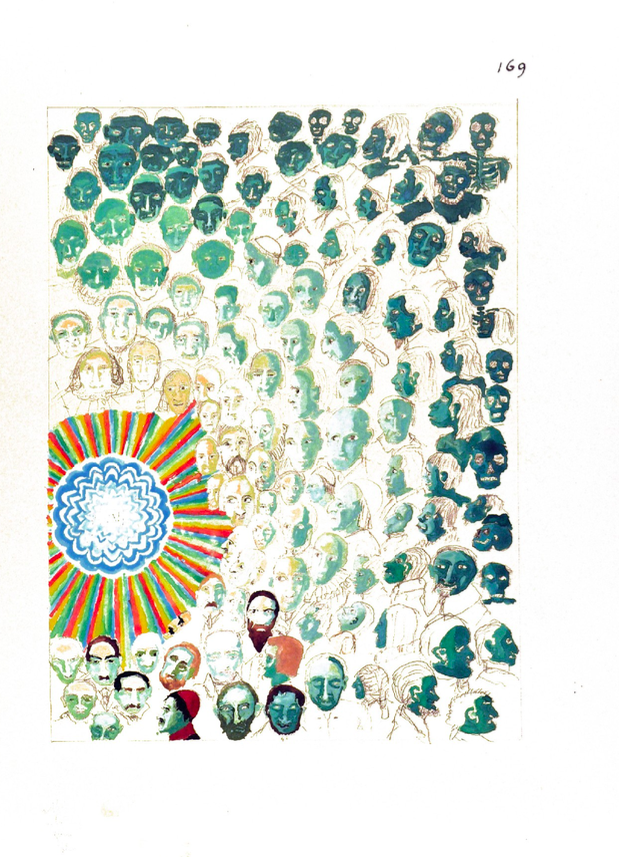
Jung leaves us with a psychological project that is unfinished. Jung is dead, having joined his ancestors, his own lament joined with that of the dead, one to which we as Jungians have trained ourselves to listen. His grand project is left mid-sentence, with the word Möglichkeit, and a clear possibility for us all to continue dreaming the myth—that is, the Christian myth—onward.
References
Giegerich, W. (2020). The collected English papers of Wolfgang Giegerich. Edited by
Giegerich, W. Vol. 6: Dreaming the myth onwards: C.G. Jung on Christianity and on
Hegel. London: Routledge, 2020.
Harrison, K. (2009). “The symbologist: ‘the red book: liber novus,’ by C. G. Jung”, The
York Times. [online] 3 Dec. Available at:
Hillman, J. and Shamdasani, S. (2013). Lament of the dead: psychology after Jung’s Red
Book. New York: W.W. Norton & Company.
Hoerni, U. (2009). Preface. In: Jung, C.G. The red book = liber novus. Edited by
Shamdasani, S. Translated from the German by M. Kyburz, J. Peck, and S.
Shamdasani. New York: W.W. Norton & Company.
Jaffé, A. and Jung, C.G. (1961). Memories, dreams, reflections. Edited by Jaffé, A. Translated
from the German by R. Winston and C. Winston. New York: Random House.
Jung, C.G. (2020). The black books 1913–1932: notebooks of transformation. Edited by
Shamdasani, S. Translated from the German by M. Liebscher, J. Peck, and S.
Shamdasani. W.W. Norton & Company.
Jung, C.G. (1968). The collected works of C.G. Jung. Edited by Read, H., Fordham, M., and
Adler, G. Translated from the German by R. F. C. Hull. Vol. 9, II: Aion: researches
into the phenomenology of the self. 2nd ed. Princeton, NJ: Princeton University Press.
Jung, C.G. (1969). The collected works of C.G. Jung. Edited by Read, H., Fordham, M., and
Adler, G. Translated from the German by R. F. C. Hull. Vol. 11: ‘Answer to Job’. In:
Psychology and religion: west and east. 2nd ed. Par. 560–758. Princeton, NJ:
Princeton University Press.
Jung, C.G. (1970a). The collected works of C.G. Jung. Edited by Read, H., Fordham, M., and
Adler, G. Translated from German by R. F. C. Hull. Vol. 10: ‘A psychological
view of conscience’. In: Civilization in transition. 2nd ed. pp. 437–55. Princeton, NJ:
Princeton University Press.
Jung, C.G. (1969). The collected works of C.G. Jung. Edited by Read, H., Fordham, M., and
Adler, G. Translated from the German by R. F. C. Hull. Vol. 9, I: ‘The psychology of
the child archetype’. In: Archetypes and the collective unconscious. 2nd ed. pp. 151–81.
Princeton, NJ: Princeton University Press.
Jung, C.G. (1970b). The collected works of C.G. Jung. Edited by Read, H., Fordham, M., and
Adler, G. Translated from the German by R. F. C. Hull. Vol. 10: ‘The undiscovered
self (present and future).’ In: Civilization in transition. 2nd ed. pp. 245–306.
Princeton, NJ: Princeton University Press.
Jung, C.G. (1923). ‘Human relationships in relation to the process of individuation’. In: M. E.
Harding, ed., Cornwall Seminars. [online] New York: Kristine Mann Library, C.G. Jung
Center, p. (leaf) 20. Available at: http://collections.library.yale.edu/catalog/10076043
[Accessed Jul. 2025]. Unauthorized notes by M. Esther Harding.
Jung, C.G. (2023). Seven sermons to the dead. Edited by Maley, S. 2nd ed. Translated from the
German by S. Maley. Towsbridge, UK: Minerva Publications.
Lusensky, J. (2024). Face to face with Christianity: dreaming the myth onward. Ashville, NC:
Chiron Publication.
Stein, M. (2015). Jung’s treatment of Christianity: the psychotherapy of a religious tradition.
Ashville, NC: Chiron Publications.