Our Capacity for Evil
Hannah Arendt & C.G. Jung
Jung’s view on evil is theologically complex but practically simple in its ethical implications. For Jung, one root of evil lies in our unconsciousness. We can do harm without seeing what we are doing. He finds support for this view in an enigmatic saying of Jesus.
“One of the toughest roots of all evil is unconsciousness, and I could wish that the saying of Jesus, ‘Man, if thou knowest what thou doest, thou art blessed; but if thou knowest not, thou art accursed, and a transgressor of the law,’ were still in the Gospels, even though it has only one authentic source. It might well be the motto for a new morality.” (C.G. Jung, CW 11, §291)
The new morality Jung imagines has an old Christian resonance. It recalls a better-known parable from the Sermon on the Mount.
“Thou hypocrite, first cast out the beam out of thine own eye; and then shalt thou see clearly to cast out the mote out of thy brother’s eye.” (Matthew 7:5)
Read psychologically, the parable warns us how easily we see in others what we fail to see in ourselves. In Jung’s terms, we project onto others what remains unconscious in us.
Jung’s view of evil finds an echo in the work of Hannah Arendt (1906–1975), one of the twentieth century’s foremost thinkers on totalitarianism. Already known for The Origins of Totalitarianism, Arendt reached a wider readership through her reporting on the 1961 trial of Adolf Eichmann in Jerusalem.
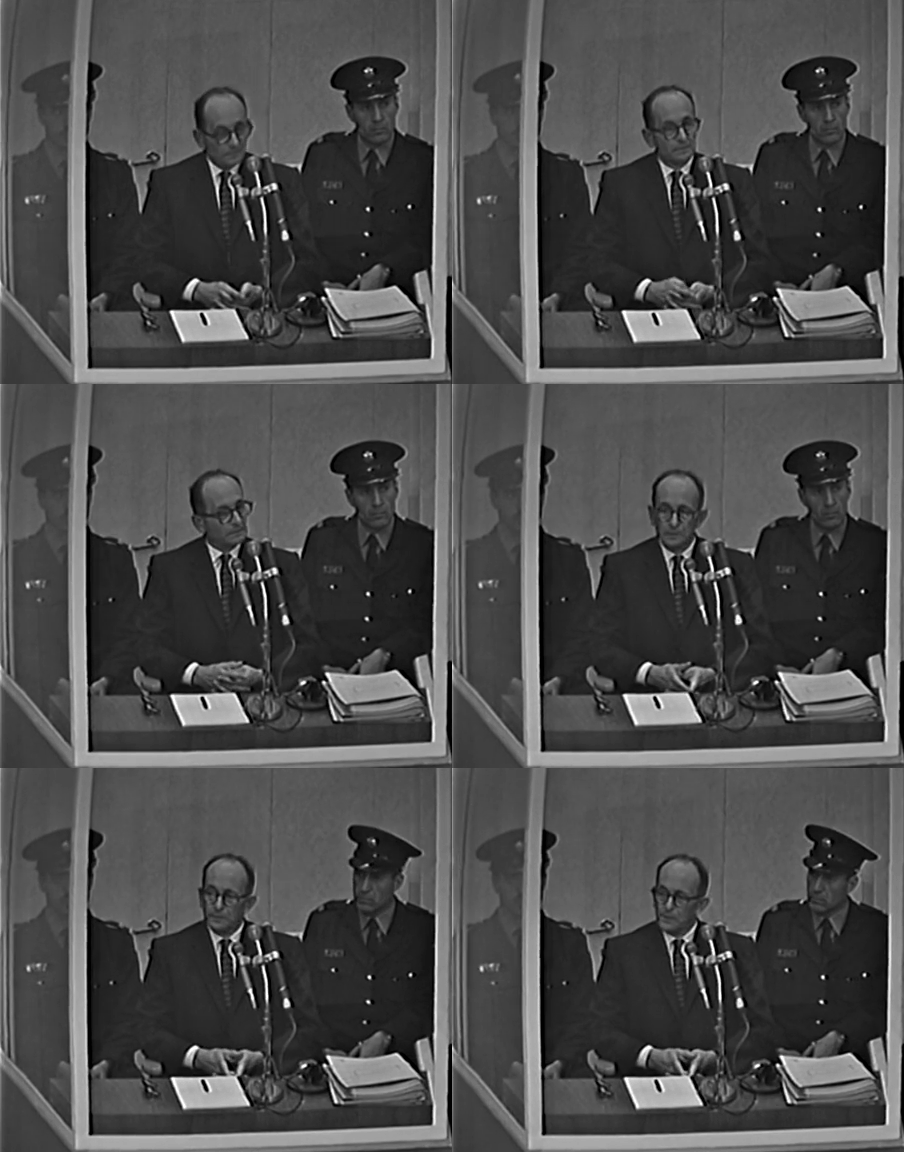
Reporting for The New Yorker, she travelled to Jerusalem to observe the trial of a man who had helped organize the deportations that enabled the murder of millions of European Jews. The proceedings began during the last months of Jung’s life. In the courtroom, Eichmann sat inside a bulletproof glass booth as evidence of the crimes was presented.
In her account, published in 1963, Arendt introduced the now familiar phrase “the banality of evil.”* What struck her about Eichmann at the trial was his thoughtlessness. He seemed unable to reflect on the immorality of his own actions or to consider them from another person’s standpoint.
“The longer one listened to him, the more obvious it became that his inability to speak was closely connected with an inability to think, namely, to think from the standpoint of somebody else.”
Hannah Arendt, Eichmann in Jerusalem, chapter 3
Arendt’s thoughtlessness and Jung’s unconsciousness describe different processes. Yet their perspectives meet in a disturbing possibility. People can participate in terrible wrongdoing while failing to question their own role in it. In the passage surrounding his appeal for a new morality, Jung invokes the Spanish Inquisition and the cruelty committed in the name of saving souls. People can remain convinced of their goodness while failing to recognize the harm they justify in its name. Arendt’s account raises a related question about the crimes people can commit while believing they are doing their duty.
For Jung, one way to reckon with our own capacity for evil is to develop our capacity for self-reflection and build a relationship with the unconscious. In Aion he writes, “Projections change the world into the replica of one’s own unknown face.” Through the work of analysis and the process of individuation, we may begin to recognize what we have been seeing of ourselves in others. We may then begin to meet the other face to face, to see them more clearly as they are and, in doing so, to see ourselves more clearly too.
*Bettina Stangneth’s research on Eichmann before the trial points to his ideological commitment and suggests that his courtroom demeanour was partly also an act.
Sources
Hannah Arendt, Eichmann in Jerusalem: A Report on the Banality of Evil (1963), chap. 3, “An Expert on the Jewish Question.”
C.G. Jung, A Psychological Approach to the Dogma of the Trinity, CW 11, §291.
C.G. Jung, Aion: Researches into the Phenomenology of the Self, CW 9ii, “The Shadow,” §17.